
How not to get lost in the forest: the Track feature in SkyForest
Updated: July 7, 2026 · Reading time: 7 min
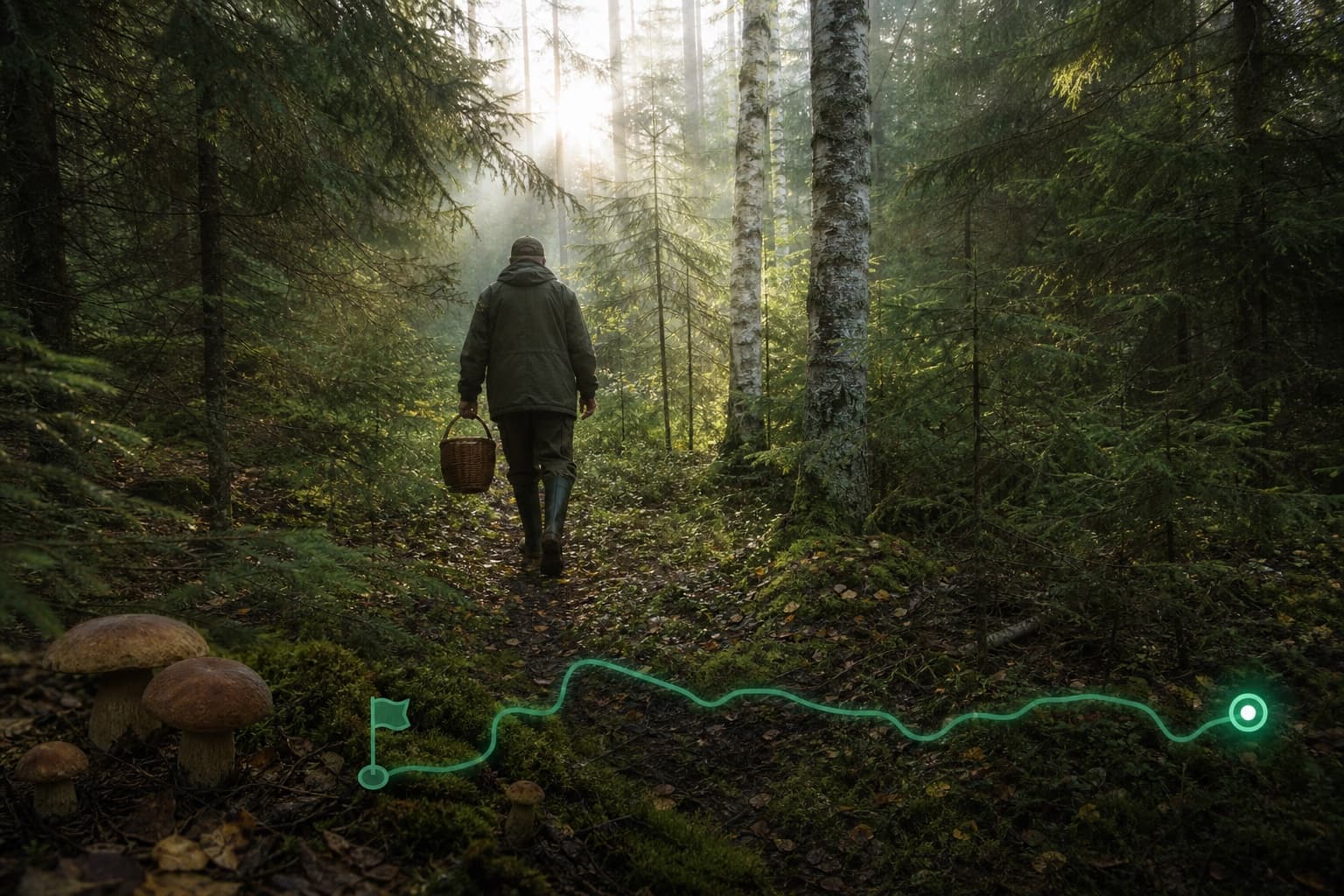
Every season, rescue teams search the woods for mushroom pickers — and more often than not it’s not beginners, but experienced foragers who have “known this forest since childhood.” It only takes following a promising mushroom patch and a couple of turns off the path before you no longer know how to find your way back in the woods to your car or the road. In this article we’ll cover how not to get lost in the forest: from basic safety rules to Track — a simple feature in the SkyForest mushroom foraging app that remembers your entry point and shows the way back.
Why foragers get lost even in a familiar forest
During a mushroom hunt your eyes are on the ground, not on landmarks. You don’t walk in a straight line — you zigzag from find to find, and your mental map quickly drifts away from reality. Add an overcast sky with no sun and uniform plantations where every ride looks the same, and after an hour of picking, the direction to the exit becomes a guess. Cell coverage and mobile data often drop out in the forest, so the online maps you rely on may simply fail to load.
Lost in the woods — what to do first
If you realize you’ve lost your bearings, the main rule is: no panic and no rushing. Here is what rescuers advise:
- Stop. Chaotic movement almost always takes you farther from the exit. Sit down, breathe, assess.
- Listen. Road noise, barking dogs, a train — acoustic landmarks carry for kilometers.
- Check your phone. GPS works even without internet: open a saved map or your track if one was recorded. Save battery — dim the screen.
- Call the emergency number. In most countries it connects even with a weak signal on any available network.
- Follow linear landmarks. A river, a power line, a forest road will sooner or later lead you to people.
But the best scenario is not getting out — it’s not getting lost in the first place. That’s exactly what Track is for.
Track in SkyForest: a GPS tracker for mushroom hunting
Track is a free feature in SkyForest. The idea is simple: before stepping into the thicket, you tap one button — “I’ve entered the forest.” From there, the app does the rest.
The entry point is your anchor
The moment you tap, Track stores your coordinates — the “anchor” you’ll return to: the forest edge, your car, the turn-off from the road. On the map the anchor is marked with a flag, and a dashed line stretches from your current position to it — the shortest direction back.
Your path on the map — without draining the battery
While you pick mushrooms, Track roughly marks your position every couple of minutes. There is no constant GPS tracking like in sports apps — so your phone doesn’t die in two hours. Your path is drawn as a dark-green line, and your current position pulses on the map. Recording continues even if you switch to other pages of the app — say, to check the weather or identify a mushroom by photo.
The return arrow: direction and distance
When it’s time to head home, open Track — a compass arrow shows where to go, with the distance to your entry point right next to it. If your device has no compass, the app falls back to plain words: “Entry: northwest, 850 m” — enough to hold a bearing by the sun or the map. Back at the car, tap “I’m out” and the track is finished.
A forest navigation app that works offline
The biggest fear in the forest is “no signal.” Track was designed precisely as offline forest navigation: the arrow, the distance and the path recording only need GPS, which works without any cellular connection. Without internet the map tiles may not load, but you will always see the direction and the meters left to your entry point. All data is stored locally on your device and is never sent anywhere: no server-side track registration, no sharing of your secret mushroom spots with anyone.
Limitations: what Track honestly doesn’t do
Track is a rough guide, not a precise route logger. Points are recorded about every two minutes and only with a solid GPS fix, so the path line is a polyline “for orientation,” not an exact replay of your route. The arrow points in a straight line — there may be a swamp or a ravine on the way that you’ll have to walk around. And most importantly: no app replaces a charged phone, a real compass, matches and common sense. Track lowers the risk of getting lost, but it doesn’t cancel basic forest safety rules.
Checklist: how not to get lost in the forest
- Tell someone where you’re going and when you plan to be back.
- Charge your phone to 100% and bring a power bank.
- At the forest edge, tap “I’ve entered the forest” in Track — it takes three seconds.
- Note which side you entered from and the major landmarks.
- Bring water, matches and bright clothing — it makes you easier to spot.
- Start heading back 2–3 hours before sunset, not “when it gets dark.”
Try Track on your next foraging trip
One tap at the forest edge — and SkyForest remembers where you entered, marks your path on the map and shows the way back. Free, with no data ever leaving your device.
Read also
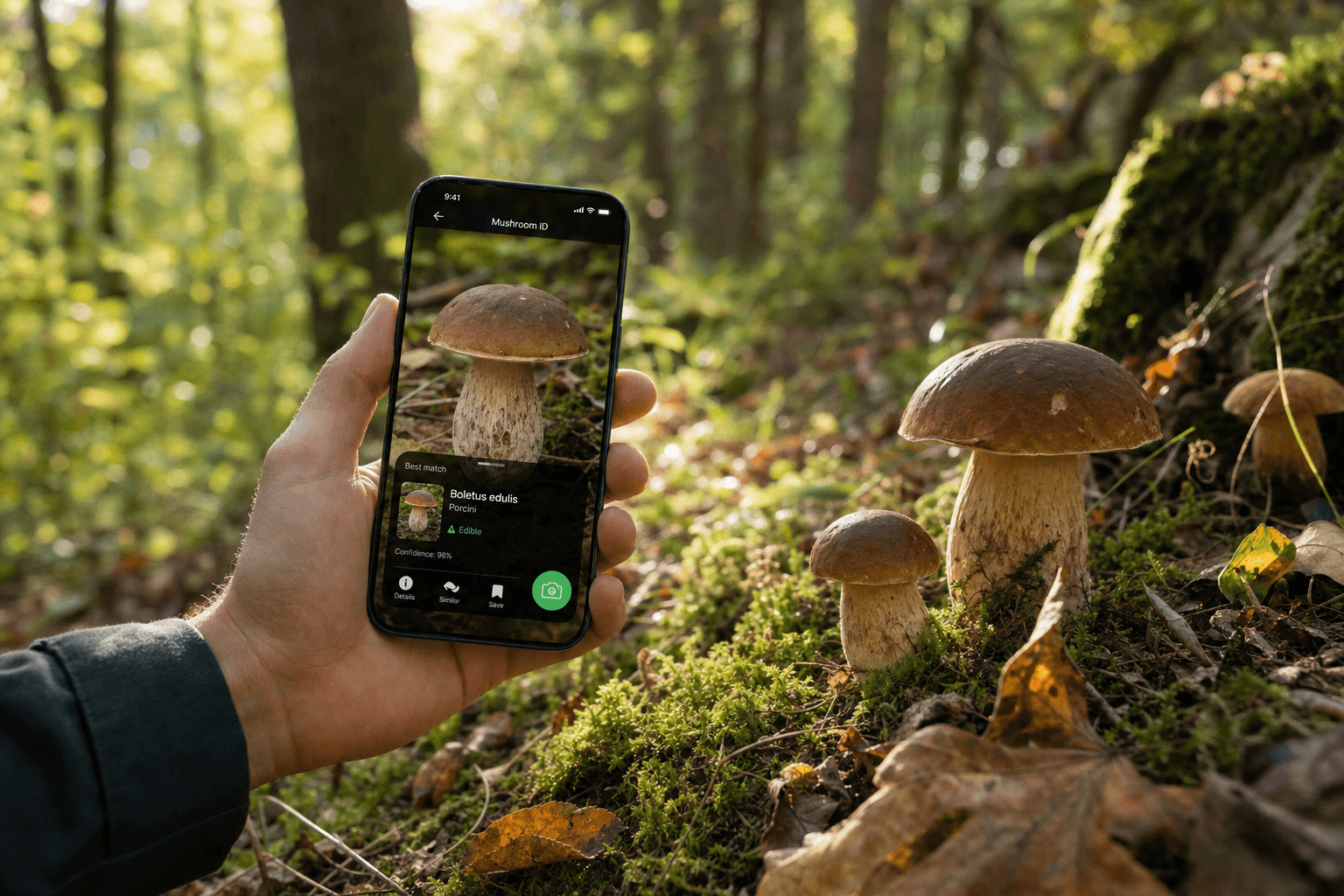
How to identify a mushroom from a photo: apps, neural networks and key features
How accurate identifiers are, what to photograph and which features to check. Plus the SkyForest identifier on Telegram.
11 min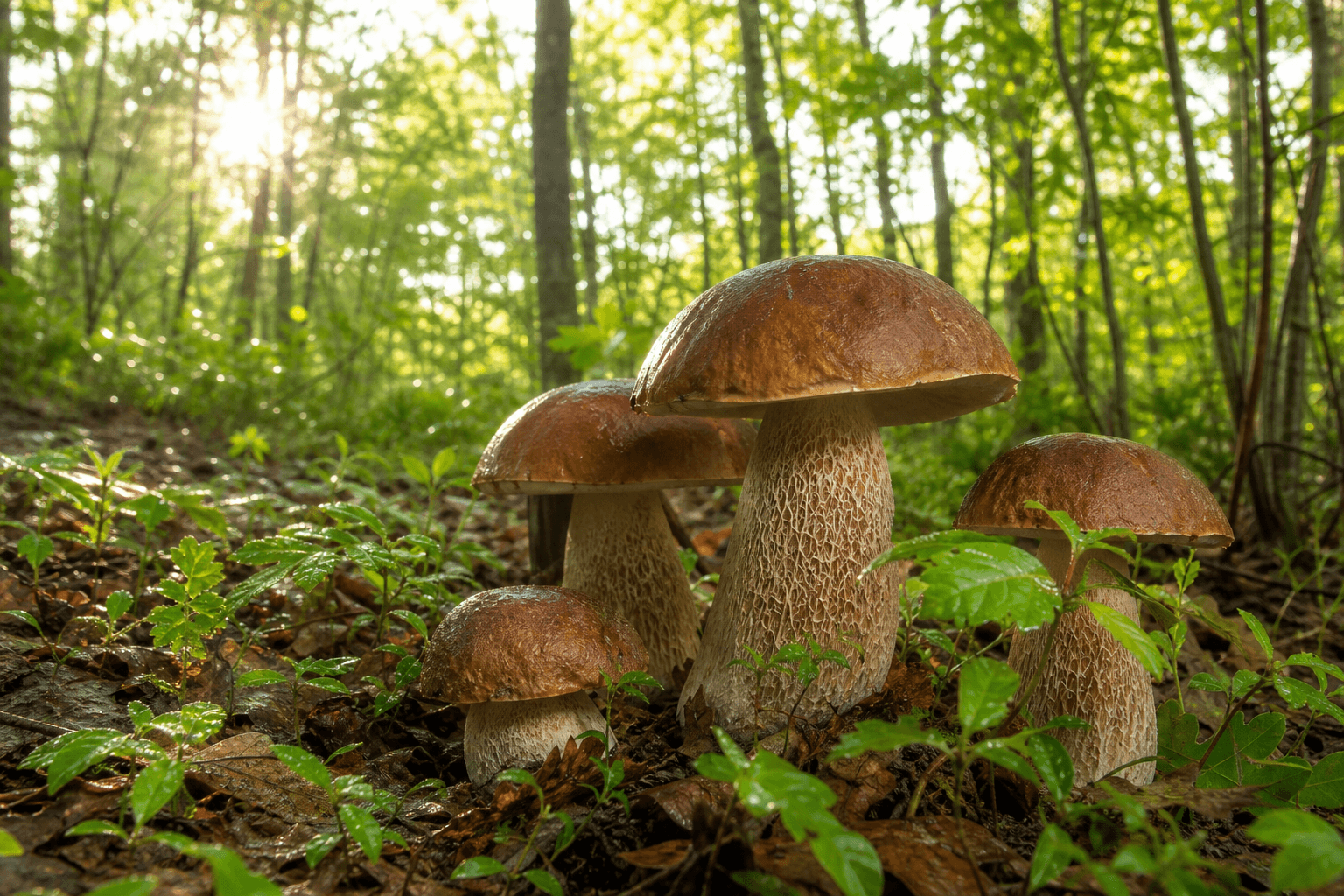
The first May porcini: where and when to find the early cep
The summer cep is the earliest porcini. Timing, locations, weather and how to tell it from look-alikes.
10 min
Weather for mushrooms: at what temperature and humidity mushrooms grow
Which weather conditions are ideal for mushroom growth. Temperature, humidity and rainfall — what matters most.
12 min
How many days after rain do mushrooms appear
The best windows after rainfall for different species. Ceps, chanterelles and honey mushrooms each have their own timing.
8 min
When it's time to head to the forest: 7 signs the mushrooms are up
Practical signs that the season has started. Soil temperature, first finds and other clues.
6 min
Which forest to search for mushrooms: coniferous, deciduous or mixed
Which mushrooms grow where: ceps in pine forests, birch boletes near birches. A guide to forest types.
10 min
Where mushrooms grow in Russia and Belarus
Regions, forests and specific spots for mushroom foraging. A map of mushroom locations and planning tips.
12 min